Showing posts with label Mweya Safari Lodge. Show all posts

Monday, 29 September 2014

The fishing village

The Kazinga Channel in Uganda is a wide, 32-kilometre long natural channel that links Lake Edward and Lake George, and a dominant feature of Queen Elizabeth National Park. The channel attracts a large variety of wild animals and birds, with one of the world's largest concentrations of hippos and numerous Nile crocodiles.
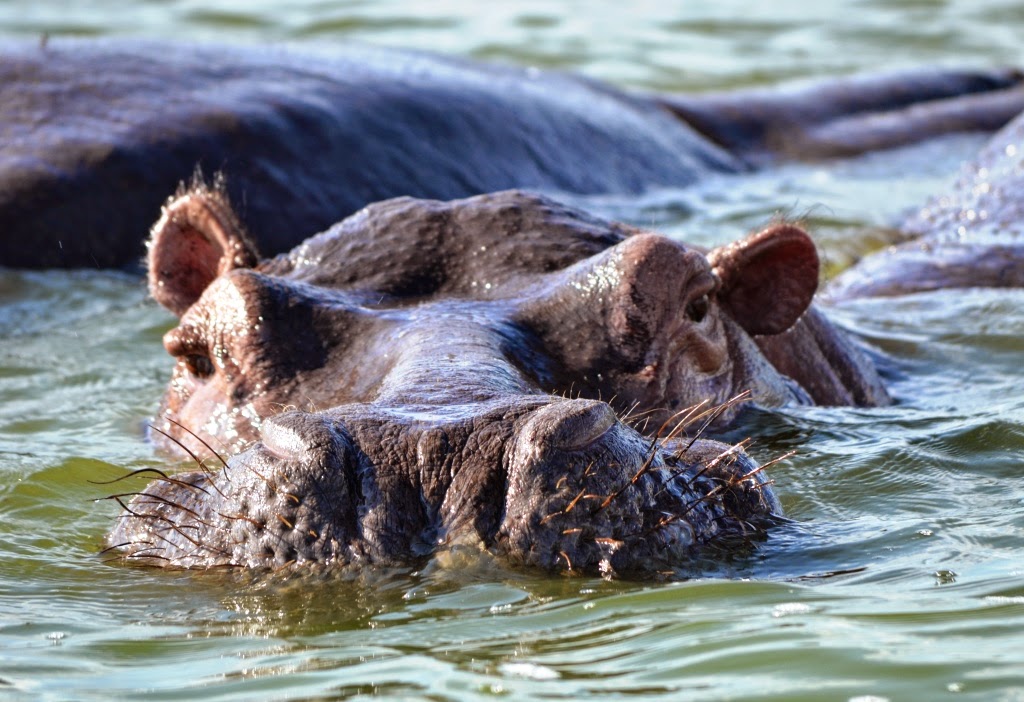
Young Hippo that swam up to the boat at Kazinga in Uganda - Corne Schalkwyk 


Crocodile on the Kazinga channel by Corne Schalkwyk 
Unlike the crocodiles that Murchison in Uganda is known for, we were told that these crocodiles only eat fish.

A boat trip down the channel is one of the best ways to explore this oasis that plays host to the fascinating species within the park, and a must for keen birders that visit Uganda.  Nestled on the banks of the Kazinga Channel you will find a small fishing village that has become an integral part not only of Queen Elizabeth national park but also of life on the channel itself.

African Skimmers landing along the Kazinga channel - Photo by Corne Schalkwyk 


 The village known as Katunguru, fishing village is also one of the best examples of sustainable tourism in Uganda.

Jacob our guide waves as we steer the boat closer to shore. A myriad of young children make their way down the banks to great us. You can’t but be reminded of the candelabra trees within the park on seeing a grouping of kids all of a similar age grouped together as they rush down to the water’s edge to great Jacob.

Jacob from Premier Safaris teaching us how to work the fishing boats in Kazinga 


Jacob himself is one of the success stories of the village, having grown up along the channel he now works for Premier Safaris known for their innovation, and providing intimate experiential experiences in Uganda. And you can’t get more intimate then being guided home by Jacob. He is taking us to meet the family, friends and fisherman that live in his village as part of our Uganda meander tour of Uganda.

Premier Safaris guide sharing some knowledge on how they approach fishing in the channel 


They say it takes a village to raise a child, and we feel as if we are returning one of their own. Smiling faces and loud greetings are exchanged as we disembark to explore the village and its people.

Smiling faces of the children of the fishing village by Corne Schalkwyk
Marasa Africa who owns the luxury Mweya Safari lodge nestled on the peninsula with views that stretch over the lazing channel, has a keen interest in the village. It’s their sustainable tourism partner and part of their $1 for the future project. The lodge includes $1 for every guest staying at the lodge and these funds goes towards community projects, such as the fishing village school project.

Mweya Safari lodge overlooking the Lakes as well as the channel 


Having seen the updates on their school project, I was keen to see the completed school at the village. And we were amazed at what they were able to achieve. What was initially a renovation project, became a rescue project as the school resembled a crumbling ruin. It now resembled a newly built school with gleaming boards and newly painted walls the school looked almost out of place in Uganda.

One of the Children running along the waters edge to great us - Photo by Corne Schalkwyk 


Having travelled through Uganda on our way to Queen Elizabeth, one can only be proud to have played a small part in this upgrade. We passed many a community that would be envious of this new school at the village. Proudly the inhabitants ask us what we think… its nice…. You like it? Are some of the questions falling around us as I try and pin out where the questions are coming from, as by now we have managed to gather a big crowd of people.


The School before they started the project 
The school after the renovations. 
We meet Jacob’s mother as she shows us her humble home, and it fills us with a sense of pride to know that Jacob our guide has come a long way, and now directly impacts on his village. 

He is able to bring tourism and tourism dollars to his isolated village. Marasa “Mweya” also buys their fish from the village creating a great partnership with the locals. 

Not only do the guest have locally sought fish on their plates but it provides and income from tourism for the village that helps not only sustain them but impacts indirectly on conservation, as they don’t need to poach the wildlife in the park to feed themselves. 

The lodge also trains and provide employment opportunities to the local people, this helps strengthen the link between tourism and conservation in the park.


 Premier as in the case of Jacob, looks for guides with years of experience and local knowledge working within the national parks in Uganda and it provides a goal for field guides in Uganda, as even our boat guide and birding expert explains that he wants to work for Premier one day.

The nature of humanity is that it actually thrives on community, starting with our families, our villages, our country and then our engagement with wider communities all structured in the same way, from grass roots upwards.

Wildlife and the community share the same space in Queen Elizabeth national park in Uganda - Photo: Corne Schalkwyk 


We often disregard the significant individual contribution we can bring to our own communities and the support that we can provide with our tourism dollars. Enhancing and supporting local schools and businesses, volunteering at football clubs or scouts, being mindful of our neighbours, helping improve local amenities, celebrating local customs and local cuisine.

All these help protect and improve our cultural heritage and the place we call home, making them better places to live in and better places to visit.Tourism has an incredible ability to touch the daily lives of people all around the world as we learn from one another and support sustainable practices.

Tourism is simply an extension of this community philosophy, reducing distances between people but at the same time enhancing cultural understanding across borders.


And yes they were right when they said they believe that unique encounters always begin off the beaten track...

With around 600 bird species the channel is a drawing card for International birders - Reed or long tailed cormorant by Corne Schalkwyk 


For more information on Premier Safaris and the Uganda meander visit www.premiersafaris.com or use the links below. 

Premier: www.premiersafaris.com  (They offer some of the best Safaris in Uganda) 

As if to say goodbye a fish-eagle flew over us as we returned to the lodge


#africantuesday #TravelUganda 

Wednesday, 11 June 2014

The Medley of Wonders!

Queen Elizabeth National Park is undeniably one of Uganda’s most popular tourist destinations.

The Kazinga channel close to Mweya Safari lodge 


 The park’s diverse ecosystems, which include sprawling savannah, shady, humid forests, sparkling crater lakes and fertile wetlands, make it the ideal habitat for classic big game safari, ten primate species including chimpanzees and over 600 species of birds can be found in this diverse ecosystem.

Set against the backdrop of the jagged Rwenzori Mountains, the park’s magnificent vistas include dozens of enormous craters carved dramatically into rolling green hills, panoramic views of the Kazinga Channel with its banks lined with hippos, buffalo and elephants, and the endless Ishasha plains, whose fig trees hide lions ready to pounce on herds of unsuspecting Uganda kob.

As well as its outstanding wildlife attractions, Queen Elizabeth National Park has a fascinating cultural history. There are many opportunities for visitors and meet the local communities within the park and enjoy storytelling, dance, music and more.
Child photographed at the Kazinga fishing village along the Channel 


Mweya Safari lodge one of the Pearls in the Marasa Africa crown hovers over the Kazinga Channel below. This 32-kilometre long, natural channel that links Lake Edward and Lake George, and is a dominant feature in the Park. The channel attracts a varied range of animals and birds, with one of the world’s largest concentrations of hippos and numerous Nile crocodiles and an incredible array of birds.

Buffalo along the Kazinga channel 


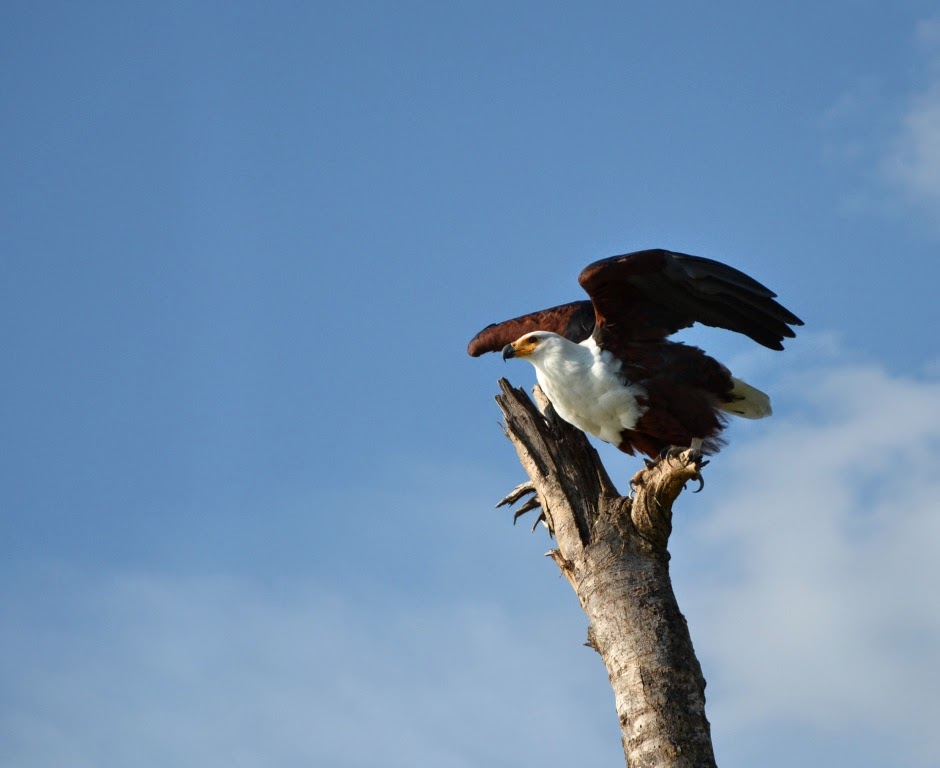
While travelling along the channel you are assured to encounter numerous fish eagles known for their very distinctive and some might say haunting call. These eagles are perched all along the channel ready to swoop down and grab fish from the water below.

Fish Eagle on perch by Corne Schalkwyk 


 It’s a spectacular sight to see them leave their perches or drag their catch to shore. But make no mistake this eagle will also catch monkeys or other birds and even crocodile hatchlings.

Take off by Corne Schalkwyk

Make sure to visit the peninsula in Queen Elizabeth to take in the spender of the reflecting water and its hidden gems.

Fish Eagle in Flight by Corne Schalkwyk 
   Uganda’s Queen Elizabeth National Park is truly a Medley of Wonders!

For bookings or information on the lodges contact Premier Safaris at www.premiersafaris.com or email reservations@premiersafaris.com

Mweya Safari lodge - www.marasa.net

Wednesday, 16 April 2014

Meet the sheriff

We tend to concentrate on the big and harries, and forget about the smaller reptiles and birds.
Today I wanted to write about birds and decided to go right for the big boy, the sheriff amongst birds so to speak. This bird is bound to get even the non-birders attention. The Martial Eagle, the largest eagle in Africa and one of the most impressive birds to encounter while on safari.


They are the largest of the African eagles and incredibly powerful, capable of knocking an adult man off his feet. They reputedly have enough power in one foot to break a man's arm. The largest eagle in Africa and one of the largest in the world, the Martial eagle weighs in at almost 6.5 Kg. The upperparts are dark brown with a white belly with black streaks; the legs are white and have very large talons. The immature bird looks quite different from the adult. The adult eagle has a body length of between 78 and 86 cms , a wingspan between 1.9 and 2.6 m

In some areas birds form an important part of the diet, including guineafowl, francolins, bustards, and poultry. Birds as large as a European Stork are recorded to have fallen prey to the Martial Eagle.
Martial Eagles feed on gamebirds, hares, hyraxes, small antelopes, monitor lizards and other medium sized vertebrates. Nests are built invariably in trees, high above ground, but often in the largest tree in the area, growing on a steep hillside or in a gorge, where the bird has a clear sweep off the nest. Martial Eagles form monogamous pairs and they usually mate for life. Pairs tend to breed once every two years and the breeding season correlates with the dry season across their geographic range. Females lay 1 - 2 eggs and incubation takes approximately 45 - 50 days. Between 90 and 100 days after hatching the youngsters are ready to fledge.


They prefer uninhabited stretches of thornbush and savannah found over much of Africa, occurring also in open plains and semi-desert country. It spends much of its time on the wing, and is usually seen soaring about hill slopes, often at a very great height rendering it almost invisible to the naked eye. Early in the morning before it takes to the wing for the day, or in the evening prior to roosting it can be seen perched in trees.


Interesting Facts: Martial Eagles are the only member of the genus Polemaetus.

These photos were taken by Corne Schalkwyk during a visit to Mweya Safari lodge – while on Safari with Premier Safaris in Uganda.


Birding Safaris in Uganda  - Premier Safaris  visit www.premiersafaris.com or email reservations@premiersafaris.com 
To visit the lodge: Mweya Safari lodge is part of the Marasa Africa Group of lodges www.marasa.net 

Thursday, 10 April 2014

The band of brothers

Last week, I travelled to Queen Elizabeth national park and more specifically Mweya Safari lodge to visit the Band of brothers.


This charismatic striped mongoose family was made famous by the BBC film about their daily lives and struggles around the lodge.

Banded mongoose much like their distant cousins the meerkats are part of the mongoose family, only twice as heavy if compared to the meerkat.

They are social animals, living in large family groups of up to 20 individuals, although the Mweya family is significantly larger than other families I have encountered at around 70 individuals.  They sleep in a underground network or whatever they can use for the same purpose and during the day they venture out of their dens in search of for food. Their diet consists mainly of scorpions, beetles, lizards, eggs and small mammals.


They forage in groups but unlike the meerkat they don’t use a century to guard the group. They need to be extremely vigilant while they are out in the open so that they aren’t surprised by predators such as birds of prey or jackals. They also stand on their hind legs as they aren’t very tall so they try to seek out the high ground in order to get a better view of their surroundings. The higher the vantage point the better so they will go to impressive lengths to find that perfect lookout post!

These banded brothers are completely wild but over time they have become habituated to humans. They have been used for research for many years and have become part and parcel of the Mweya Safari lodge experience.


If you are patient you can easily gain their trust and get up close and personal with these inquisitive little fellows.  They would even allow some people to touch them although we don’t recommend it.
All the members of the group are related to each other and you can have up to 9 generations in the same family.


The banded mongoose doesn’t have a single dominant pair and interestingly the females are able to time their date of birth to coincide to create a nursery environment. These pups are then raised by the family as a unit.
This family has been part of ongoing research since 1994 providing a fascinating insight into their species and social system.

For those interested in meeting these little fellows, you can always contact “Premier Safaris” at reservations@premiersafaris.com or look for programmes on their website at www.premiersafaris.com

Mweya Safari lodge is part of the Marasa Africa group of lodges in East Africa – www.marasa.net

Saturday, 13 July 2013

Hear Us Roar – 10th August 2013


“I was not the lion, but it fell upon me to give the lion’s roar” Winston Churchill, politician, 1874-1965

 
Photo by Patti Baker Trottier
Guarding our temples, adorning our flags, decorating our coins and capturing our hearts, the lion is beyond doubt the world’s most iconic species.  On almost every continent, and in thousands of cultures, the lion can be found demonstrating man’s fascination with this magnificent beast.

A half -century ago some 100,000 lions ranged across Africa’s savannahs, but lion habitat is only a quarter of what is was then and today lion numbers are fewer than 30,000. Forty per cent of these live in Tanzania and only nine countries can claim to have more than 1,000 wild living lions. Currently classified as ‘Vulnerable’ by the International Union for the Conservation of Nature (IUCN) the wild lion has been ousted from over 75% of its previous habitats on this continent in the last century, making scientists and conservationists alike feel that all species of African lion are well on their way to extinction.

World Lion Day is the first global campaign to celebrate the importance of the lion worldwide and to call attention to the need for conservation efforts in the lions’ behalf.  Organizers say, “Since the dawn of man, the lion has played an integral role in our lives:  symbolically, religiously, culturally, economically and biologically.  To lose the lion from our world would be to lose part of our global heritage.”

Marasa Africa, a member of the Madhvani Group of Companies, one of the largest private-sector groups in East Africa, announces it will join Uganda Conservation Foundation in supporting World Lion Day, August 10, 2013, a day that will be marked around the world to call attention to the endangerment of the King of Beasts.  On that date, Marasa properties in Uganda – Chobe Safari Lodge; Paraa Safari Lodge and Mweya Safari Lodge, will donate $1.00 for each room night at these lodges to the non-profit Uganda Conservation Foundation (UCF) Conservation through Action programmes provide practical support to revitalise and protect natural habitats, biodiversity and also helps protect lions in the national parks from poachers. This will also benefit the vulnerable tree climbing lions in ishasha Guests of the lodges will also be invited to donate to the UCF.

Guests can see the splendid lion in his natural habitat by going on game drives at Chobe Safari Lodge and Paraa Safari Lodge, both in Murchison Falls National Park, and both scenically situated on the River Nile.  And they can view a particular wonderment – tree-climbing lions – while on safari at Mweya Safari Lodge. Mweya is located in Queen Elizabeth National Park on the amazing natural channel, Kazinga, running between salt water Lake Edward and fresh water Lake George. The channel attracts a varied range of animals and birds, with one of the world’s largest concentrations of hippos and numerous Nile crocodiles.

Arrangements to see the Ugandan lions can be made through Premier Safaris. 

For more information on World Lion Day, visit: www.worldlionday.com